IP67 Waterproof DC Motors vs. Standard Motors: Which One Does Your Project Really Need?
When sourcing micro DC motors for industrial automation, robotics, or outdoor smart equipment, engineering teams and procurement managers often face a crucial decision: Should you stick with a standard DC gear motor, or invest in a fully sealed waterproof motor?
While a standard motor might seem cost-effective initially, choosing the wrong protection rating can lead to equipment downtime, water ingress failures, and costly field repairs. Below is a comprehensive B2B guide breaking down the structural differences, application scenarios, and ROI of waterproof motors versus standard motors.
1. Structural Differences: What Makes a Motor Truly Waterproof?
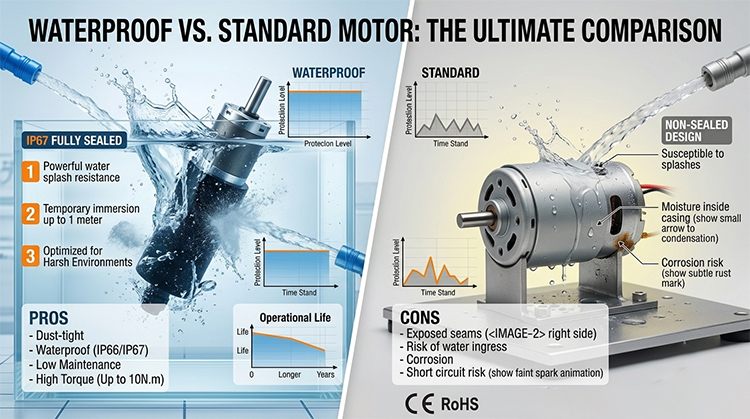
The primary difference lies in the internal sealing engineering and protective enclosure.
-
Standard DC Motors: Designed primarily for dry, indoor environments. They usually feature standard dust covers, open housing seams, and exposed wire lead-out points. While efficient for controlled indoor conditions, moisture and dust particles can easily penetrate the motor body, causing short circuits or gear wear.
-
IP66/IP67 Waterproof Motors: Specially engineered with heavy-duty rubber O-rings, dynamic oil seals on the output shaft, fully sealed housings, and waterproof cable glands. This sealed construction prevents water jets, high humidity, condensation, and fine dust particles from entering the gearbox and motor windings.
2. IP Protection Ratings Explained: Standard vs. Sealed
Understanding IP (Ingress Protection) ratings is essential for sourcing the correct motor:
-
Standard Motors (IP40 - IP54): Protect against larger solid objects and light splashing water, but cannot withstand direct rain, high-pressure water jets, or temporary immersion.
-
Waterproof Motors (IP66 - IP67):
-
IP66: Protects against powerful water jets from any direction—ideal for washdown industrial machinery.
-
IP67: Withstands temporary immersion in water (up to 1 meter depth for 30 minutes)—essential for outdoor robotic applications and solar trackers.
-
3. Key Application Scenarios Comparison
| Feature / Application | Standard DC Gear Motor | IP67 Waterproof Planetary Motor |
| Typical Environment | Dry indoor, controlled humidity | Outdoor, washdown, humid, dust-heavy |
| Key Applications | Office automation, smart home blinds, indoor conveyors | Solar trackers, agricultural robotics, marine equipment, medical washdown gear |
| Moisture Resistance | Low (risk of corrosion & short circuit) | High (fully sealed anti-corrosion structure) |
| Maintenance Need | Higher in harsh conditions | Maintenance-free long service life |
4. ROI & Total Cost of Ownership: Is Waterproof Worth It?
While an IP67 waterproof DC motor has a slightly higher upfront manufacturing cost due to specialized seals and precision housing, it offers a significantly lower Total Cost of Ownership (TCO) in demanding applications.
By eliminating liquid-induced motor failures, waterproof planetary gear motors prevent catastrophic equipment breakdowns in the field—saving thousands of dollars in warranty claims, maintenance labor, and customer trust.
Need Customized Waterproof Motor Solutions?
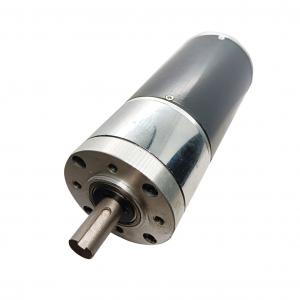
At Shanghai Meichu Industrial Co., Ltd., we specialize in both standard and highly customized micro DC motors. From 32mm IP67 waterproof planetary gear motors with custom shaft geometries (D-shaft, threaded, or splined) to flexible voltage setups (12V, 24V, 36V DC) and speed ranges from 9 to 2050 RPM, our engineering team delivers tailored transmission solutions designed for harsh environments.
Planning a new robotics or outdoor automation project? Contact our technical support team today at [info@shmeichu.com] for rapid sampling and professional OEM support